What Adobe Summit 2026 Actually Showed Me (And Why CX Is the Real Headline)

Who writes this?
Ignacio Mancilla
What Adobe Summit 2026 Actually Showed Me
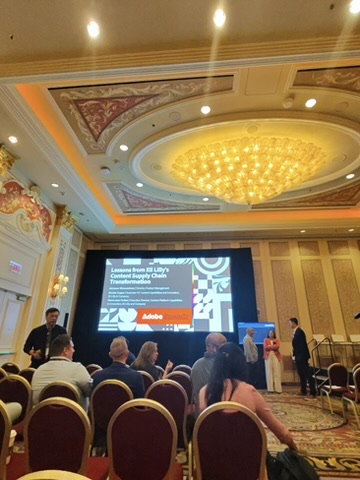
Vegas in late April is already loud. Drop 10,000 digital experience people into the Venetian and you get that specific kind of controlled chaos only a tech conference can pull off.
I landed Saturday. Badge pickup Sunday. By Monday morning I’d already run into three former clients and a guy I hadn’t seen since a CMS migration in 2019. That’s Summit. Half conference, half reunion.
This year the theme was clear the second the opening keynote kicked off: the rise of the agentic enterprise. And honestly? For the first time in a while, the hype felt earned.

The Real Headline: CX
Every Summit has a word. This year’s word was CX — customer experience. And no, it’s not a new acronym. What’s new is how seriously Adobe is treating it as a system problem, not a tool problem.
Quick definition for anyone who doesn’t live in this world: customer experience (CX) is the full arc of how someone perceives a brand. Every ad, every page, every email, every chatbot reply, every “your package arrived” push. For years the industry treated each of those as separate projects. Separate vendors. Separate dashboards.
Adobe’s bet for 2026: glue it all together with AI agents. They’re calling it Customer Experience Orchestration — CXO.
The marquee announcement was Adobe CX Enterprise, an end-to-end agentic system that ties together AI agents, agent skills, and MCP (Model Context Protocol) endpoints under a governance layer. Sitting on top of it is CX Enterprise Coworker, which is the piece I spent the most time looking at. It acts as an orchestrator — watching signals, recommending next actions, executing across channels in real time, with a human kept in the loop.
Two numbers from the keynote that stuck with me:
- AI traffic to US retail sites climbed 269% year-over-year in March 2026.
- Adobe expanded partnerships with AWS, Anthropic, Google Cloud, IBM, Microsoft, NVIDIA, and OpenAI. Essentially every serious agentic stack.
Jensen Huang’s segment was exactly the performance you’d expect. But the line I wrote down wasn’t his. It came from a P&G exec who said: “We stopped asking what AI can do. Now we ask what it shouldn’t do.” That’s the right question.
What I Was Actually Hunting For
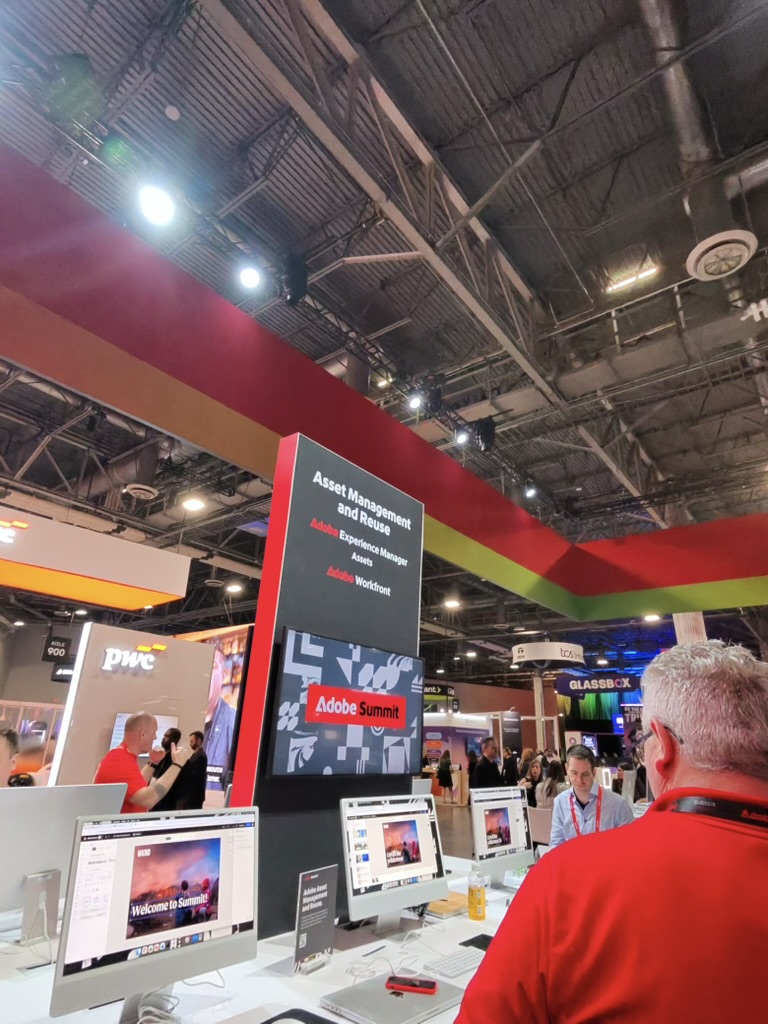
CX Enterprise is the big story. But I came to Summit with my own shortlist, and three things topped it: Experience League, Adobe Learning Manager, and the AEM + Edge Delivery Services track.
Experience League + Adobe Learning Manager
I work with enablement every single week. Clients need certified teams. Partners need playbooks. The whole ecosystem runs on whether people can actually learn this stack. So when Adobe dropped the April 2026 updates for Experience League and Adobe Learning Manager, I paid attention.
For Experience League:
- Non-logged-in browsing now works. Visitors can see the full catalog and course details without a login wall. Sounds small. It’s not — SEO finally applies to Adobe’s learning content.
- Personalized homepage with recommendations based on profile, history, and progress.
- AI Assistant built into the learning experience.
For Adobe Learning Manager (April 2026 release):
- Fluidic Player now shows the next module name and a real Exit button. IYKYK.
- Captivate content gets a unified table of contents and slide-level completion tracking.
- Multi-language support for Job Aids, checklist questions, and VTT video tracks.
- Zoom Connector finally handles multiple concurrent VILT sessions.
- Public API upgrades around alternates, equivalents, time-windowed content access, and Job Aid management.
None of these are flashy. All of them fix things that have been friction points for years. That’s the stuff that actually moves the needle for enablement teams.
AEM and Edge Delivery Services
I’ll be honest — this was the track I was most excited for. EDS is where the interesting architectural work is happening right now, and 2026 does not disappoint.
Cloud Manager 2026.4.0 dropped April 2nd. Two features that matter most to me:
- Smart Build — builds now compile only the modules that changed, using module-level caching. For any project with more than a handful of blocks, this cuts pipeline time from annoying to tolerable.
- MCP server for AI-enabled IDEs — Cloud Manager’s Public APIs are now exposed as tools for MCP-compatible IDEs like Cursor. You can manage programs, pipelines, environments, and repositories through a conversational prompt. I tried it on my laptop between sessions. It works.
AEM Edge Functions is the other one worth flagging. JavaScript running at the CDN layer, closer to the user, with near-zero hydration. Combine that with the atomic-blocks model EDS already runs on, and you get a genuinely fast delivery pipeline.
And the beta I’ll be chasing the second I’m back at my laptop: EDS with AEM Authoring. Author in the familiar AEM Author environment, deliver via EDS. This one’s been asked for since Franklin was called Franklin.
What I’m Taking Home
Summit is a fire-hose. You can’t process everything in the moment. So here’s what I’m still thinking about on the flight back:
- CX Enterprise isn’t a product. It’s a posture. The companies that win the next few years won’t be the ones with the most agents. They’ll be the ones whose agents know how to say no.
- Enablement is the quiet lever. If your team can’t use the tools, the tools don’t matter.
- EDS keeps getting better in ways that compound. Smart Build + MCP + Edge Functions feels like the point where AEM is finally meeting modern-web expectations on performance.
If you were at Summit, I want to hear what hit you. If you weren’t, and any of this lands on something you’re building right now, send me a note. Coffee’s on me.
Who writes this?
Ignacio Mancilla
AEM Solutions Architect | AI Engineer